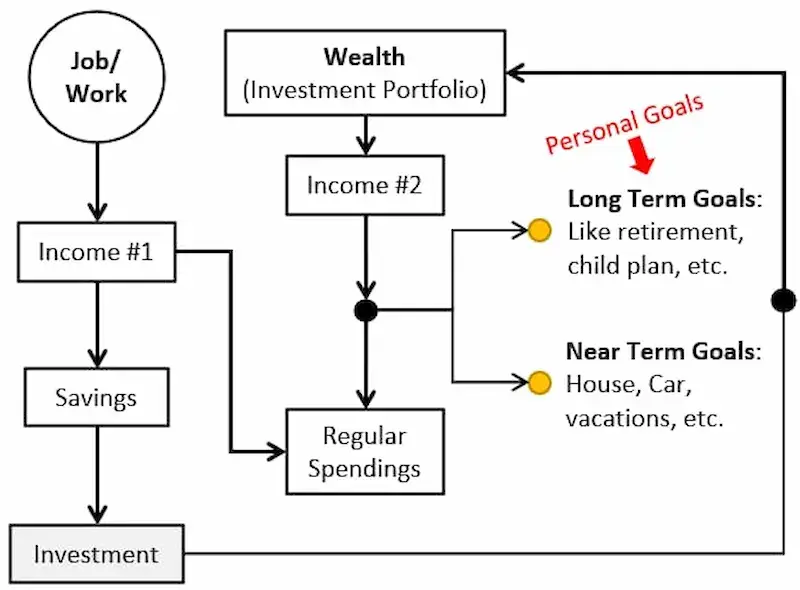
It takes more than just investing in the newest popular mutual fund or identifying the next profitable stock to build wealth. Managing risk while allowing your money to increase consistently over time is the key to successful investment. Diversification can help with that.
You are already asking one of the most crucial questions in personal finance if you have ever wondered how to construct an investment portfolio. A well-diversified portfolio lowers needless risks, strengthens the basis for long-term financial success, and shields your investments from market volatility.
Many new investors make the error of investing all of their funds in a single asset because they think it will yield the highest returns. This strategy exposes investors to large losses in the event that the investment underperforms, even if it may occasionally yield substantial gains. By distributing your funds over several asset classes, diversification ensures that no single investment has the ability to significantly impact your financial future.
This thorough guide will teach you how to create an investing portfolio in India, recognize the value of diversification, identify the most effective asset allocation techniques, and find doable strategies for striking a balance between risk and reward.
READ MORE: https://marketmantra2026.in/etf-vs-mutual-fund-for-beginners/ https://x.com/DhanValue/status/2076125891906904480?s=20
What Is an Investment Portfolio?
All of your financial assets combined make up an investing portfolio. These resources may consist of:
Stocks
Mutual funds
Index funds
ETFs, or exchange-traded funds
Bonds
Deposits that are fixed (FDs)
Gold
Property
Fund for Public Provident (PPF)
System of National Pensions (NPS)
Foreign investments
Both cash and liquid assets
A diversified portfolio, as compared to a single investment, consists of multiple assets that exhibit distinct behaviors under different market circumstances.
Realizing that each investment has a unique purpose is the first step in understanding how to build an investing portfolio. Some create growth, some offer stability, and some safeguard your wealth in times of economic uncertainty.
Why Diversification Matters
A saying, “Don’t put all your eggs in one basket,” sums up diversification quite well.
Consider putting all of your savings into the stock of a single company. Your wealth increases quickly if the business does very well.
By distributing assets over several businesses, sectors, and asset classes, diversification lowers this risk.
- Advantages consist of:
- Reduced total risk in the portfolio
- Long-term returns that are more consistent
- Diminished effects of market crashes
- Improved defense against inflation
- Increased financial adaptability
Global investing businesses’ research regularly demonstrates that choosing individual stocks has a much less impact on long-term portfolio performance than asset allocation.s.
Understanding Asset Allocation
Understanding asset allocation is crucial before knowing how to construct an investment portfolio.
Asset allocation is the process of allocating your funds across several investment categories according to your:
Financial objectives
Age
Tolerance for risk
Horizon for investments
Stability of income
Every asset class reacts to the state of the economy in a distinct way.
For instance:
Although they are more volatile, stocks often offer larger growth.
Investments in debt yield comparatively steady returns.
In times of uncertainty, gold frequently does well.
Long-term wealth generation and diversification are provided by real estate.
In an emergency, cash offers liquidity.
The ideal combination is determined by your unique situation rather than by adhering to someone else’s portfolio.
Step 1: Define Your Financial Goals
Every investment needs to have a goal.
Consider this:
Do you have money set aside for retirement?
Purchasing a home?
Paying for your kids’ schooling?
generating revenue passively?
Creating long-term wealth?
How aggressively or cautiously you invest depends on your objectives.
In general, a person saving for a home purchase in three years may tolerate less market volatility than someone investing for retirement over a 25-year period.
For this reason, knowing how to in three years.
For this reason, establishing specific financial goals is the first step in learning how to construct an investing portfolio.
Step 2: Assess Your Risk Tolerance
Your level of comfort with market volatility is measured by your risk tolerance.
In general, there are three types of investors:
Conservative
Prioritize stability above large profits.
Appropriate investments consist of:
- Deposits that are fixed
- Bonds issued by the government
- Mutual Funds for Debt
- The PPF
Moderate
Stability and growth should be balanced.
A well-rounded combination of gold, debt, and stocks is frequently effective.
Aggressive
Prioritize building long-term wealth.
It might be beneficial to allocate more money to equities, index funds, and equity mutual funds.
Step 3: Diversify Across Asset Classes
Spreading assets over a variety of asset classes is the cornerstone of building an investing portfolio.
Equities
The greatest potential for long-term gain is found in equity investments.
Among the options are:
- Direct stocks
- Index funds
- Funds with a flexible cap
- Mutual funds with large capitalizations
- Mid-cap investments
- Small-cap investments
Despite short-term volatility, Indian stocks have historically produced appealing long-term returns.
Debt Investments
Your portfolio is stabilized with the use of debt instruments.
Examples include of:
- Mutual funds for debt
- Securities issued by the government
- Bonds for corporations
- Deposits that are fixed
- Bonds with RBI Floating Rates
During market downturns, these assets lessen volatility.
Gold
Historically, gold has been used as a hedge against economic uncertainty and inflation.
Indian investors have the option of:
- Bonds of Sovereign Gold
- ETFs for gold
- Mutual Funds for Gold
- Electronic Gold
- Real Gold
Financial advisors frequently advise keeping gold exposure to a small percentage of the total portfolio.
Real Estate
One of the most well-liked long-term investments in India is still real estate.
Real Estate Investment Trusts (REITs), which offer real estate exposure without buying actual property, are another option available to investors in addition to residential real estate.
International Investments
Global diversification lessens reliance on the economy of a single nation.
International markets are accessible to Indian investors via:
- Global mutual funds
- International ETFs
- International index funds
Portfolio diversification can be enhanced by exposure to businesses in the US, Europe, and other developed regions.
Step 4: Diversify Within Equities
Many investors think that diversification is automatically created by buying a variety of equities.
Not always.
Your portfolio stays concentrated if all of your investments are in the same industry.
Instead, spread out your business across sectors like:
Banking
Information Technology, Healthcare, FMCG, Energy, Infrastructure, Manufacturing, and Consumer Products
Sector diversification reduces hazards unique to a company and an industry.
Step 5: Invest Regularly Through SIPs
In many cases, consistency is more important than timing.
Investors can make set monthly contributions to Systematic Investment Plans (SIPs).
Advantages consist of:
The average cost of rupees
Discipline in investing
Compounding over time
Diminished emotional investment
Because SIPs eliminate the need to forecast market fluctuations, they greatly simplify the process of building an investment portfolio for beginners.
Step 6: Review and Rebalance Your Portfolio
Diversification is a continuous process.
Your asset allocation automatically shifts when markets do.
Assume that investments in stocks grow far more quickly than those in debt.
It’s possible that your portfolio will become riskier than you anticipated.
Rebalancing involves periodically modifying investments to restore your desired allocation.
Portfolio reviews should be done once or twice a year, according to the majority of financial advisors.
Sample Diversified Portfolio
For a moderate-risk investor, consider this example.
| Asset Class | Allocation |
|---|---|
| Equity Mutual Funds | 45% |
| Index Funds | 20% |
| Debt Funds | 15% |
| Gold | 10% |
| International Funds | 5% |
| Cash & Liquid Funds | 5% |
This is simply an example. Your proper allocation should be in line with your risk tolerance, investment horizon, and personal objectives.
Common Portfolio Diversification Mistakes
Stay clear of these common errors.
Investing Only in One Asset
Concentration risk grows if you invest all of your money in stocks, gold, or real estate.
Ignoring International Exposure
India’s economy frequently performs differently from global markets.
Country-specific risk is decreased via international diversity.
Chasing High Returns
Future outcomes are not guaranteed by past success.
Don’t make an investment only because an asset has recently produced remarkable returns.
Over-Diversification
Possessing an excessive number of comparable funds adds needless complication without appreciably lowering risk.
Prioritize quality over quantity.
Ignoring Inflation
Overstuffing low-return assets can eventually lower one’s purchasing power.
The long-term goal of a balanced portfolio should be to beat inflation.
Expert Opinion on Diversification
Diversification is one of the best risk management techniques, according to many prosperous investors.
Harry Markowitz, the economist who won the Nobel Prize and is frequently referred to as the founder of modern portfolio theory, has said that diversity is “the only free lunch in investing.” His study showed that diversifying investments might lower overall portfolio risk without necessarily compromising expected returns.
For Indian investors looking for long-term financial security, this idea is still quite important.
Who Should Build a Diversified Portfolio?
Almost all investors gain from diversification, including:
New investors
Professionals with salaries
Entrepreneurs
Independent contractors
Parents putting money aside for their kids’ education
Planners for retirement
Builders of long-term wealth
Diversification contributes to a more robust investment approach regardless of income level.
Final Thoughts
One of the most important financial skills you can acquire is how to create an investing portfolio. Instead than looking for a single investment that offers exceptional returns, concentrate on building a balanced portfolio that incorporates growth, stability, liquidity, and risk protection.
Although it doesn’t completely remove risk, a diversified portfolio aids in its wise management. You may lessen the effects of market volatility and increase your chances of obtaining steady long-term returns by distributing your investments among stocks, debt, gold, real estate, foreign assets, and cash.
Keep in mind that building an investment portfolio does not include replicating the investments of others. It involves knowing your financial objectives, assessing your risk tolerance, selecting the appropriate asset allocation, making consistent investments, and routinely analyzing your portfolio.
Those who are able to forecast every change in the market are not the most successful investors. They are the ones who maintain their discipline, diversify, and take advantage of compound interest and time. Learning how to create an investment portfolio is a great place to start if you’re serious about attaining long-term financial security.
Frequently Asked Questions
How may I begin constructing an Indian investing portfolio?
Establishing an emergency fund, determining your financial objectives, evaluating your risk tolerance, and investing in a variety of asset types, including stocks, debt, gold, and foreign funds, are the first steps. Rather of focusing on short-term gains, understanding how to construct an investing portfolio starts with rigorous preparation.
How should novices allocate their assets?
A universal formula does not exist. While conservative investors might favor a larger allocation to debt and fixed-income securities, younger investors with longer investment horizons might devote more to stocks.
How frequently should my portfolio be rebalanced?
Every six to twelve months, or whenever your asset allocation significantly shifts as a result of market volatility, the majority of experts advise examining and rebalancing your portfolio.
Can investment risk be completely eliminated through diversification?
No, diversification lowers risk but does not completely remove market risk. It lessens the negative effects of bad performance from any one asset type or investment.
Can I use a modest monthly investment to create a diverse portfolio?
Indeed. Even with a little monthly payment, it is easy to progressively create a diversified investment portfolio because many mutual funds and index funds allow SIPs starting at ₹500.