Investing is now more readily available than it has ever been. One investing option constantly stands out—the S&P 500 index if you’re a working professional preparing for retirement, a college student saving your first salary, or someone trying to increase wealth over time. Millions of investors worldwide now like it because of its decades-long track record and the recommendations of many of the top investors.
If you’ve been looking for how to invest in S&P 500 index fund, you’ve already taken a significant step toward diversifying your investment portfolio. Rather than attempting to forecast which individual stock will perform best, an S&P 500 index fund allows you to invest in hundreds of America’s largest publicly traded companies with a single transaction.
This tutorial will explain how to invest in S&P 500 index fund, why it has become one of the most trusted long-term investing strategies, the various methods you can invest, the expenses involved, potential hazards, and practical recommendations to help you get started with confidence.
READ MORE: https://marketmantra2026.in/how-to-build-an-investment-portfolio/https://marketmantra2026.in/best-index-funds-for-beginners-2026/ https://x.com/TheETFTracker/status/2077048221457633787?s=20
What Is an S&P 500 Index Fund?
An S&P 500 index fund is a mutual fund or Exchange-Traded Fund (ETF) that seeks to replicate the performance of the S&P 500 Index, one of the world’s most popular stock market benchmarks.
The index contains about 500 of the largest publicly traded firms in the United States from a variety of areas, including technology, healthcare, banking, consumer products, communication services, industrials, and energy.
Some of the globally recognized companies in the index include Apple, Microsoft, NVIDIA, Amazon, Alphabet (Google), Meta Platforms, Berkshire Hathaway, JPMorgan Chase, and ExxonMobil.
Instead of picking individual equities, the fund simply duplicates the index by owning the same companies in equal proportions. This passive investment strategy minimizes management costs while offering broad diversification.
Learning how to invest in S&P 500 index fund is beneficial since it provides exposure to many of the world’s strongest companies without requiring significant stock-picking skills.
Why Do Investors Prefer the S&P 500?
The S&P 500 has earned a reputation as one of the most dependable long-term investing benchmarks. Over lengthy periods of time, it has produced average annual returns of roughly 10% before inflation, while yearly returns can vary greatly depending on market conditions.
- Its popularity stems from various benefits:
- Broad diversity over hundreds of enterprises.
- Investment fees are lower when compared to actively managed funds.
- Exposure to worldwide competitive businesses.
- Long-term wealth generation potential.
- Simple investment method that requires little maintenance.
Warren Buffett, the legendary investor, has often argued that most individual investors would benefit from investing in low-cost S&P 500 index funds rather than attempting to outperform the market through regular trading.
Why Beginners Should Consider an S&P 500 Index Fund
One of the most difficult problems for new investors is deciding on individual equities. Even experienced professionals struggle to regularly exceed the entire market.
An S&P 500 index fund reduces most of this uncertainty.
Instead of relying on the success of a single company, your investment is dispersed over hundreds of businesses in many industries.
Benefits include:
- Reduces company-specific risk.
- Automatic diversification.
- Professional fund management.
- Lower expense ratios.
- Easy long-term investment.
One of the most appealing aspects of the S&P 500 index fund for new investors is its simplicity.
How to Invest in S&P 500 Index Fund
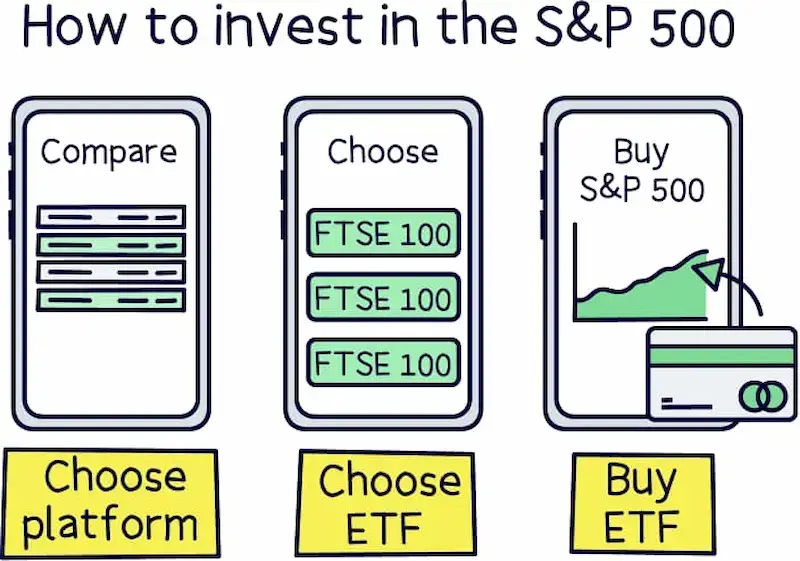
Understanding how to invest in S&P 500 index fund is easier than many people think. Typically, the process takes only a few stages to complete.
Step 1: Define Your Investment Goal
Decide why you want to invest before you do so.
Common goals include:
- Retirement Planning
- Wealth Creation
- Financial independence
- Children’s Education
- Long-term savings.
Your investing objective determines how much risk you can tolerate and how long you should stay engaged.
Step 2: Choose Between an ETF and an Index Mutual Fund
There are two main ways to invest.
S&P 500 ETFs
Exchange-Traded Funds trade on stock markets alongside normal shares.
Advantages include:
- Lower expense ratios.
- Intraday trading.
- High liquidity.
Some jurisdictions prioritize tax efficiency.
Popular examples include:
- Vanguard’s S&P 500 ETF (VOO)
- SPDR S&P 500 ETF Trust (SPY)
- iShares Core S&P 500 ETF (IV
S&P 500 Index Mutual Funds
Direct purchases of mutual funds are made through fund firms or investing platforms.
Advantages consist of:
- Investing automatically every month.
- No need to keep an eye on market prices every day.
- An investment technique that is easy for beginners.
Select the option that most closely aligns with your platform availability and investing style.
Step 3: Open an Investment Account
You’ll need an account with a brokerage or investment platform.
Depending on your country, this could consist of:
- Accounts for online brokerages
- Accounts for retirement
- Apps for investing
- Global investment platforms
Subject to appropriate rules, Indian investors can also have exposure to the S&P 500 through international mutual funds, exchange-traded funds (ETFs), or licensed foreign investing platforms.
Step 4: Decide How Much to Invest
The ideal investment amount does not exist.
Many investors start off with modest monthly contributions and progressively raise them as their income rises.
A good strategy is to:
- First, create an emergency fund.
- Make regular investments.
- Steer clear of investing funds that are required for immediate needs.
Frequent investing is frequently more successful than attempting to time the market flawlessly.
Step 5: Invest Regularly
Making regular contributions instead of waiting for the “perfect” market opportunity is one of the best methods to invest.
This tactic helps average out purchasing prices over time and lessens emotional investing.
Recognizing that consistency is frequently more crucial than ideal timing is another aspect of how to invest in S&P 500 index funds.
Best S&P 500 Index Funds
Many funds have established solid reputations for their affordability and effective tracking.
| Fund | Type | Key Advantage |
|---|---|---|
| Vanguard S&P 500 ETF (VOO) | ETF | Very low expense ratio |
| SPDR S&P 500 ETF Trust (SPY) | ETF | High liquidity |
| iShares Core S&P 500 ETF (IVV) | ETF | Long-term investing |
| Fidelity 500 Index Fund (FXAIX) | Mutual Fund | Low management fees |
| Schwab S&P 500 Index Fund (SWPPX) | Mutual Fund | No minimum investment for many accounts |
These funds may vary slightly in terms of fees, minimum investment requirements, and trading features even though they follow the same index.
Costs You Should Understand
Investing is not 100% free.
The fund’s yearly fee is shown by the expense ratio, which is the main expense.
Thankfully, the majority of S&P 500 index funds have incredibly low fees—typically less than 0.10% per year.
Because even minor variations can have a big impact on long-term results through compounding, it’s critical to keep costs down.
Risks of Investing in the S&P 500
No investment is risk-free, even though the S&P 500 has historically delivered appealing long-term returns.
Some the risks are:
Market Risk
Naturally, stock markets change.
S&P 500 funds may temporarily decrease during economic downturns.
Currency Risk
Exchange rate swings might result in benefits or losses for foreign investors.
Economic Risk
Market performance can be impacted by things like inflation, rising interest rates, recessions, and global unrest.
Emotional Investing
During market downturns, a lot of investors panic and sell at the worst moment.
Short-term market fluctuations are frequently less important than long-term discipline.
Common Mistakes to Avoid
New investors often make mistakes that may be prevented.
Trying to Time the Market
It is quite challenging to forecast short-term market fluctuations.
In general, consistent investing yields superior long-term outcomes.
Investing Without Diversification
Even if the S&P 500 is diversified, depending on their objectives, investors should think about balancing their entire portfolio with bonds, foreign assets, or other asset classes.
Ignoring Costs
Long-term returns are lowered by higher fees.
Selecting cheap funds maximizes the growth of investments.
Checking the Portfolio Every Day
Price changes on a daily basis are typical.
Investors who are successful typically prioritize long-term growth above short-term volatility.
Should Indian Investors Invest in the S&P 500?
Investing abroad can offer Indian investors significant variety outside of their own market.
Numerous globally major businesses that bring in money from all over the world are part of the U.S. market.
In addition to providing access to industries that might not be well-represented in India, adding S&P 500 exposure to an Indian portfolio may help lessen reliance on the economy of a single nation.
However, before making an international investment, investors should also take into account things like currency fluctuations, taxes, investment laws, and overall asset allocation.
Expert Perspective
Passive investment reduces expenses while capturing market growth, which is why many financial professionals advise it.
Many actively managed funds regularly underperform their benchmark over extended investment periods, according to research from the S&P Dow Jones Indices SPIVA Scorecards. This has made low-cost index investing more appealing to institutional and ordinary investors alike.
An S&P 500 index fund can be a potent basis for wealth creation when combined with long-term thinking and disciplined investing.
Final Thoughts
One of the best financial choices that many long-term investors can make is to learn how to invest in S&P 500 index funds. An S&P 500 index fund exposes you to hundreds of America’s biggest and most reputable firms with a single investment, as opposed to trying to find tomorrow’s winning stock.
It has been a mainstay of investment portfolios all across the world due to its diversification, affordability, ease of use, and potential for long-term gain.
Knowing how to invest in S&P 500 index funds can help you develop a disciplined investment strategy, whether your goals are long-term wealth growth, retirement, or financial independence. The secret is to invest continuously, keep expenses low, maintain diversification, and let compounding work over many years rather than attempting to forecast short-term market moves.
Learning how to invest in S&P 500 index funds could be one of the most beneficial financial skills you acquire if you’re just starting out. It will give you a strong basis for reaching your long-term financial objectives.
Frequently Asked Questions
How much money must be invested in an S&P 500 index fund?
The brokerage or fund provider determines the minimum investment. Certain platforms enable investors to buy fractional ETF shares or begin with a relatively small sum.
Is it safe to invest in an S&P 500 index fund?
No investment carries no risk at all. However, because S&P 500 index funds offer wide diversification among about 500 major U.S. companies, they are thought to be comparatively less hazardous than investing in individual equities.
Is it possible for Indian investors to make S&P 500 investments?
Indeed, subject to relevant laws and tax laws, Indian investors can obtain exposure through foreign mutual funds, exchange-traded funds (ETFs), or authorized foreign investment platforms.
Which is superior, an index mutual fund or an S&P 500 ETF?
They both want to follow the same index. While index mutual funds might be more practical for automatic, long-term investing, exchange-traded funds (ETFs) allow intraday trading and frequently reduced fee ratios.
How long should I continue to invest?
Long-term investors are typically the best candidates for the S&P 500. You can take full advantage of compound interest and market growth by holding onto your investments for at least seven to ten years.