A sharp drop in gold and silver ETFs may seem confusing because gold and silver are frequently seen as protective investments. The latest change has been most visible in India, where silver ETFs plummeted more steeply than gold ETFs during the September 28 sell-off.
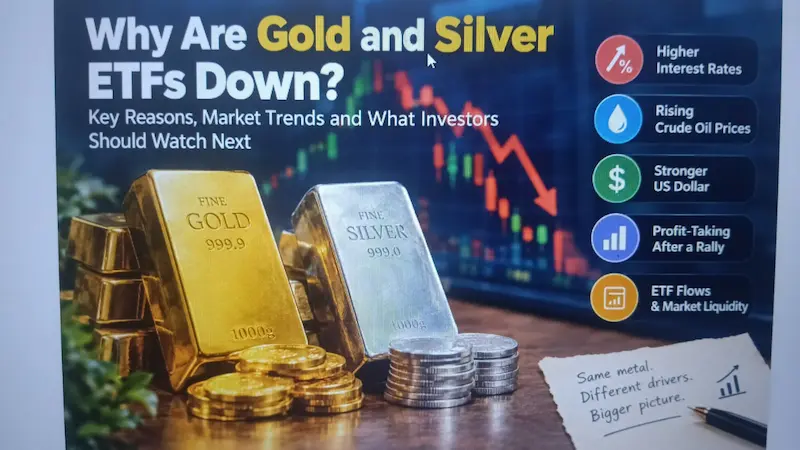
So, Why are gold and silver ETFs down? The immediate reason is not that silver or gold suddenly lost all of their value. Rather, a number of market trends moved in the same direction, including rising crude oil prices, growing fears about inflation, rising US Treasury rates, growing expectations for further rate rises by the Federal Reserve, and a stable US currency.
The opportunity cost of owning precious metals, which don’t yield dividends or interest, increased as a result of those modifications.
This article explains Why are gold and silver ETFs down?, why silver has been more volatile, what is going on behind the ETF price, and what investors should keep an eye on going forward.
READ MORE: https://marketmantra2026.in/what-is-expense-ratio-in-mutual-funds/ https://x.com/GlobalMktObserv/status/2103774713189396520?s=20
What Happened to Gold and Silver ETFs?
As the price of metal fell globally on September 28, 2026, there was significant selling pressure on Indian gold and silver ETFs. According to Business Standard, precious metals saw a significant decrease in gold and silver ETFs due to rising bond yields and growing anticipation of additional rate hikes by the US Federal Reserve. Gold ETFs dropped more than 2% throughout the session, while silver ETFs dropped as much as around 4%, according to Mint.
The action was taken in response to a particularly severe drop in the global market. As the market responded to rising oil prices, higher Treasury rates, and increased expectations for tighter US monetary policy, spot gold dropped over 4% on September 28 and hit a seven-week low, according to Bloomberg.
Instead of a clear reversal, the next day saw modest stabilization. Reuters reported on September 29 that spot silver stayed marginally lower while gold recovered almost 1% from the sell-off during the previous session. The fact that gold was still nearing a seven-week low indicated that the overall pressure had not yet been removed by the recovery.
For investors searching Why are gold and silver ETFs down?, The difference is important since a one-day recovery does not always show the underlying pressure has gone away.
How Gold and Silver ETFs Actually Work
The purpose of a gold exchange-traded fund (ETF) is to familiarize investors to gold without requiring them to keep actual bars or coins. The basic idea of a silver ETF is the same. Although the relationship is not exactly the same every minute, these funds’ prices often move in the same direction as the metal because they are tied to the underlying commodity. That means that an ETF may decline even in the lack of a major issue inside the fund.
For instance, an Indian gold ETF may face pressure if global gold prices fall suddenly. In a similar vein, silver ETF prices may quickly decline in response to a sharp decline in silver prices. Gold ETFs are identified in SEBI-filed scheme documentation as passively managed products that track domestic gold prices while acknowledging the possibility of tracking discrepancies.
So when investors ask Why are gold and silver ETFs down?,Instead of assuming the ETF management has made a mistake, it is crucial to start with the underlying commodity.
1. Higher US Interest-Rate Expectations
One of the main causes of the recent downturn is this. Interest income is not produced by gold or silver. Investors may be able to increase their profits on interest-bearing assets without taking on the same kind of commodity-price exposure when government bond yields climb. For precious metals, this leads to an opportunity-cost dilemma.
The mechanism can be seen clearly by the current market reaction. On September 29, Reuters reported that markets were placing the likelihood of another Federal Reserve rate increase in October at about 70% and in December at roughly 95%.
Treasury securities and other yield-producing assets may become more appealing than gold as projected rates rise. It is not a mechanical consequence.
If investors are concerned about geopolitical risk, currency weakness, financial instability, or other issues, gold prices may still climb during high rates. However, the pressure on non-yielding metals can increase significantly if rates rise quickly and investors start pricing in more tightening.
2. Rising Treasury Yields
Why is this important for an Indian gold or silver exchange-traded fund? because the US financial market has a significant impact on precious-metals pricing worldwide. Investors reevaluate the relative appeal of owning non-interest-bearing assets as Treasury yields increase.
Because gold is typically held as a store of value rather than an asset that generates income, the relationship is especially significant.
This is one reason Why are gold and silver ETFs down? cannot be solved by focusing only on mood in the Indian stock market. The global bond market is quite important.
3. A Stronger US Dollar
US dollars are used for calculating the price of gold and silver abroad. Precious metals may cost more to purchasers using other currencies as the dollar appreciates. Demand at the margin may decrease as a result. Higher rates and a stronger US dollar were factors in the September sell-off.
Both of these reasons were noted by Reuters as obstacles for gold. There is an extra layer for Indian investors. The rupee-dollar exchange rate, local market conditions, and the global gold price all have an impact on the price of gold domestically.
For an Indian investor, a stronger dollar can therefore have two opposing effects: it can put pressure on the price of metals abroad, while a weaker rupee can somewhat offset that decrease when converted into rupees.
For this reason, the movement of an Indian ETF may not always precisely correspond to the percentage change in global gold.
4. Rising Crude Oil Prices Are Changing Inflation Expectations
One of the most important features of the current story is this. Concerns about inflation were rekindled by the significant increase in oil prices.
Transportation, manufacturing, and other sectors of the economy may benefit from higher energy costs. Investors may anticipate that central banks will maintain higher interest rates for longer if they think inflation may continue to be high. This starts a domino effect:
Higher oil prices → higher inflation concerns → higher rate expectations → higher bond yields → greater pressure on non-yielding metals.
Reuters particularly connected rising oil prices and the ensuing anticipation of stricter US monetary policy to the September 28 gold sell-off.
Therefore, the recent drop in gold and silver was more than just a narrative about precious metals. Inflation and interest rates played a role.
The short-term answer to Why are gold and silver ETFs down? therefore begins outside the precious-metals market itself.
5. Profit-Taking After a Powerful Rally
Global gold-backed ETFs added $18 billion in August, according to the World Gold Council, and by the end of the month, total holdings had risen to a record 4,189 tons.
One of the factors driving the August rise was strong ETF purchasing. Some investors finally lock in gains when an asset climbs quickly. When the market experiences a negative catalyst, like higher rates or a stronger dollar, that selling may become more intense.
Due to its smaller market and more volatile pricing than gold, silver can be more vulnerable.
Therefore, a pullback following a significant rally does not always indicate that the long-term investment case has vanished. It implies that positioning and expectations are subject to rapid change.
6. Why Silver ETFs Are Falling More Than Gold ETFs
Silver has typically showed greater fluctuations when looking at recent ETF moves. There is a structural explanation. Silver is an industrial commodity as well as a precious metal. It is employed in fields like solar-related technologies, electronics, and automotive applications.
Silver now has two significant demand drivers, but investors now have more factors to take into account. According to the Silver Institute, the global silver market will continue to be in deficit for the sixth year in a row in 2026.
Simultaneously, it predicts a 2% decrease in industrial fabrication to roughly 650 million ounces, in part due to substitution and a decrease in the amount of silver used per unit in photovoltaic applications.
This combination generates a unique market. While worries about industrial activity may put pressure on silver, long-term supply-demand restrictions may sustain it. This contributes to the explanation of silver’s ability to move quickly in both directions.
7. Silver Is More Volatile Than Gold
Due of its limited market size and industrial exposure, silver’s changes in price may be enhanced. Assume a 2% decline in gold. Silver’s decline need not be precisely 2%. Depending on positioning, futures activity, industry forecasts, and investor sentiment, it could decline less, stay steady, or decline significantly.
The main difference can be seen by recent data from the Indian market. According to Mint, gold ETFs fell by more than 2% on September 28, while silver ETFs fell by as much as over 4%. This difference does not prove that silver is fundamentally flawed. It serves as a reminder that the price of silver is typically more volatile.
8. ETF Prices Can Also Be Affected by Market Liquidity
Beginners occasionally miss another detail. A stock exchange is where an ETF trades. Throughout the trading session, buyers and sellers have an impact on its market price. On the other hand, the underlying metal is traded on international commodity markets.
The market price of the ETF may momentarily fluctuate at a modest premium or discount to the value of its underlying assets during times of extreme volatility. The discrepancy may not go away right away, but market makers and arbitrage mechanisms usually seek to keep it under control.
When considering a sudden intraday move, this is especially important to keep in mind. The underlying gold or silver may not have decreased by precisely the same proportion if there is a brief ETF discount.
9. Gold and Silver Can Fall Even When Geopolitical Risks Remain High
A common question is:
“If gold is a safe-haven asset, why is it falling when geopolitical uncertainty is still elevated?”
because gold reacts to multiple forces once. The demand for safe-haven investments may increase due to geopolitical risk. However, same characteristics may work against you if the same environment also results in higher oil costs, higher inflation expectations, higher bond yields, and a stronger dollar. As a result, the market balances conflicting pressures.
For this reason, the adage “gold rises during uncertainty” should never be taken for granted. The question that is more helpful is: Which force is currently controlling the market? This is yet another crucial aspect of comprehension. Why are gold and silver ETFs down?
10. ETF Flows Can Amplify the Move
Fund managers typically have to increase exposure to the underlying metal or similar products when investors purchase gold ETFs.
The converse may occur when investors lower their exposure. The August figures from the World Gold Council demonstrated the strength of ETF demand. During the month, $18 billion was drawn to global gold-backed ETFs, increasing holdings to a record 4,189 tons and total assets under administration to over $615 billion.
But everything changed in September. According to Reuters, there was a little withdrawal of roughly 1.6 tons from gold ETFs in the week preceding the September 28 sell-off. Considering the scale of the worldwide ETF market, that is not a huge outflow, but it shows how investor flows can vary when sentiment shifts.
Why Are Gold and Silver ETFs Down Even Though Gold Had a Strong Year?
The time horizon becomes important at this point. An asset may be: Increased greatly over a number of years A great deal lower than a recent peak unpredictable during the previous month Positive during the year It is possible for all four things to be true once.
Investors frequently make the error of valuing an asset only based on its most recent peak. Let us say an ETF increases from ₹50 to ₹80 before declining to ₹70. From its peak, it has dropped 12.5%. However, the price is still 40% more than the initial ₹50. The longer-term return is still positive despite the current decrease.
Given that both gold and silver saw significant price changes in 2026, this gap is especially crucial.
What Should Gold ETF Investors Watch Now?
Investors might keep an eye on a number of factors instead of attempting to forecast the next daily move.
US Treasury Yields
Precious metals may continue to be under pressure if yields keep climbing. The opportunity-cost pressure on gold may lessen if yields stable or decrease.
Federal Reserve Expectations
Because inflation and employment figures can alter rate expectations, markets are keeping a tight eye on upcoming US economic data. As of September 29, Reuters listed coming ADP employment, PCE inflation, and nonfarm payroll data as critical market factors.
The US Dollar
Commodities priced in dollars may be impacted by a stronger currency. A decreasing dollar may be helpful.
Crude Oil
Oil’s relationship to inflation expectations has made it especially significant. Markets may continue to fret about monetary policy and inflation if energy costs stay high.
ETF Flows
Recurring inflows may indicate a recovery of demand for investments. Continuous withdrawals may be a sign that investors are lowering their exposure.
Central-Bank Purchases
One significant structural source of the demand for gold is still central banks. Even in times of temporary weakness, that component can offer assistance.
What Should Silver ETF Investors Watch?
Silver requires an additional checklist.
Investors should monitor:
- Industrial demand
- Solar-sector silver usage
- Electronics demand
- Automobile production
- Global manufacturing activity
- Physical investment demand
- Mine production
- Recycling
- Gold-to-silver relative pricing
- ETF and futures positioning
Physical investment is predicted by the Silver Institute to increase in 2026 while several industrial and jewelry demand categories declining. This explains why a single indication cannot be used to examine silver.
Is the Fall in Gold and Silver ETFs a Buying Opportunity?
The answer is not universal. A decrease in price does not prove that an asset is inexpensive. After an initial correction, gold and silver may continue to decline, especially if rates and the currency keep rising.
However, investors who think the macroeconomic pressure has already been represented in prices may eventually be drawn to a dramatic collapse. Investors can inquire about more than just if the ETF is declining.
- What is causing the decline?
- Has the underlying metal stabilized?
- Are Treasury yields still rising?
- Are Fed rate expectations changing?
- Are ETF flows improving?
- Is the investment horizon short term or long term?
- Does the position fit the portfolio’s risk level?
Asking those kinds of inquiries is more beneficial than responding to a single bad trading session. Check see Why are gold and silver ETFs down before determining the significance of the decline. and determine whether rates, currency, positioning, commodities, or fundamental demand are the sources of the pressure.
Gold ETF vs Silver ETF During a Correction
| Factor | Gold ETF | Silver ETF |
|---|---|---|
| Main exposure | Gold | Silver |
| Industrial demand | Relatively limited | Very important |
| Typical volatility | Lower | Higher |
| Interest-rate sensitivity | High | High |
| Dollar sensitivity | High | High |
| Safe-haven role | Stronger | More limited |
| Industrial-cycle exposure | Lower | Higher |
| Price swings during stress | Usually smaller | Often larger |
This does not imply that silver is always riskier or that gold is always safer. This indicates that the two metals have distinct economic properties.
A Simple Example
Let us say an investor has ₹1 lakh in an ETF for silver. The price of silver drops by 4%. The investment could drop by about ₹4,000 if tracking discrepancies, fees, and other factors are ignored. Let us say an ETF for gold drops 2%.
A position worth ₹1 lakh might drop by about ₹2,000. The precise figures are not the crucial lesson. It is the importance of portfolio allocation. The behavior of a 40% investment to a risky asset can differ significantly from that of a 10% allocation.
Should Investors Panic When Gold and Silver ETFs Fall?
Investing in commodities involves some short-term volatility. Silver and gold do not travel in a straight line.
Rallies, corrections, abrupt reversals, and times when macroeconomic considerations predominate over fundamentals will all occur. Making a long-term decision based on a single day’s price fluctuation is frequently the worst error. Rather, investors ought to differentiate between:
Price correction
and
Change in long-term investment thesis.
They are not automatically the same thing.
The deeper answer to Why are gold and silver ETFs down? It much more complex than merely stating that “gold is weak.” Interest rates, inflation, currencies, energy prices, and investment positioning are all being repriced at the same time by the market.
The Psychology Behind Precious-Metal Corrections
Usually do isolated headlines cause markets to shift. New customers may be drawn in by a rally. These purchasers drive up prices. Even more attention is drawn to higher pricing. Expectations eventually become unreal.
Investors may then reevaluate their positions in response to an unforeseen shift in bond yields, oil prices, or monetary policy. To lock in earnings, some people sell. Some sell because their trading strategies have evolved.
Still others sell because risk limits have been triggered.
A feedback loop may result from that. Prices decline. Investors start to get anxious. There are fewer positions. The decline picks up speed. The underlying long-term fundamentals may not have changed by the same amount.
A Practical Framework for Investors
Use a straightforward foundation rather than an emotional response to a bright red day.
Step 1: Check the underlying metal
Examine the actual prices of gold or silver.
Step 2: Check US yields
Find out if Treasury yields are increasing or decreasing.
Step 3: Check the dollar
There may be more pressure if the dollar is strong.
Step 4: Check oil
Expectations for inflation may be impacted by rising crude prices.
Step 5: Check Fed expectations
Examine whether the markets forecast tighter or looser monetary policy.
Step 6: Check ETF flows
Flows can show whether investors are increasing or decreasing their exposure.
Step 7: Check your own allocation
Depending on the size of the stake in your portfolio, a market correction can feel quite different. Investors can avoid basing their decisions only on headlines by using this strategy.
Final Conclusion
So, Why are gold and silver ETFs down?
Higher oil prices, renewed fears about inflation, rising US Treasury yields, increased expectations for rate hikes by the Federal Reserve, a stronger dollar, profit-taking, and shifting investor positioning are all contributing factors to the recent slump.
Silver continued to be more erratic, while gold saw a significant decline on September 28 before partially recovering on September 29. Thus, the current downturn appears to be more complex than a straightforward “safe-haven assets are failing” narrative.
A further important factor for Indian ETF investors is that while the ETF price represents the underlying metal, it can also be impacted by market liquidity, tracking discrepancies, fees, and currency fluctuations.
The bigger lesson is that gold and silver should be analyzed through multiple lenses.
Watch interest rates.
Watch bond yields.
Watch the dollar.
Watch oil.
Watch ETF flows.
Additionally, keep an eye on industrial demand for silver. Above all, do not assume that a declining ETF indicates a core problem. Markets frequently move before the economic narrative becomes clear. Generally speaking, it is more beneficial to comprehend the motivations behind the decision rather than responding emotionally to it.
Frequently Asked Questions
Why are gold and silver ETFs down today?
Higher oil costs, growing fears about inflation, rising Treasury rates, a stronger dollar, and higher the hope for additional rate hikes by the Federal Reserve have all been connected to the most recent a decline. Following a strong earlier gain, gold also saw profit-taking.
Why are silver ETFs falling more than gold ETFs?
Silver has a much higher industrial-demand component and is typically more volatile. Larger price swings can also result from changes in manufacturing, solar, electronics, and investor posture.
Do gold ETFs always rise when inflation increases?
No. Long-term inflation can help gold, but how the market reacts to inflation depends on how it impacts real yields, interest rates, currencies, and investor expectations.
Can gold ETFs fall when interest rates rise?
Yes. Since gold does not pay interest or dividends, higher interest rates may make it more expensive to own gold.
Are gold ETFs safer than silver ETFs?
The risk features of gold and silver are different. Gold typically has a stronger safe-haven role, whereas silver typically undergoes more price risk. Neither should be regarded as risk-free.
Should I sell my gold or silver ETF after a sharp fall?
Your investing goal, time horizon, allocation, and risk tolerance all play a role in this. The value of selling is not decided simply by a temporary drop in price.
What should I monitor before investing in gold or silver ETFs?
Keep an eye on the underlying metal price, the US dollar, crude oil, ETF flows, US Treasury yields, Federal Reserve expectations, and—especially for silver—industrial demand.
Can gold and silver ETFs recover after a sharp fall?
They can bounce back, but it is unclear how they will do in the future. Monetary policy, exchange rates, investor flows, geopolitical developments, and economic conditions continue to have an impact on precious metals.