The standard checklist for investors selecting an index fund or exchange-traded fund (ETF) is simple: fee ratio, returns, AUM, fund house, and possibly prior performance. However, tracking error is another figure that deserves further attention.
The purpose of an index fund is to conform to a specific benchmark. For instance, if a fund tracks the Nifty 50, its goal is not to outperform the Nifty 50 by skillfully selecting stocks. Its task is to replicate the benchmark as well as feasible.
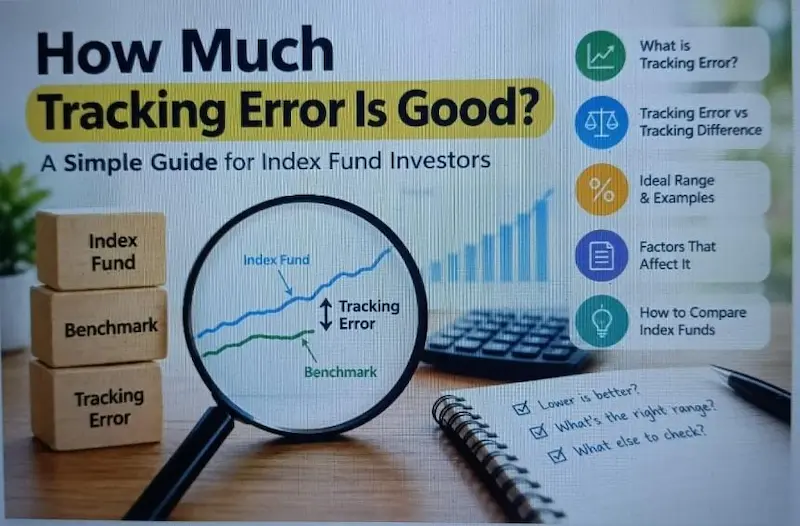
That raises an obvious question: how much tracking error is good for an index fund?
Although there is not a single number that is automatically “good” for every index fund or ETF, the short answer is that generally speaking, lower is better. For one kind of index, a 0.20% tracking error might be great, but for another, it might not be as spectacular.
In addition, a tracking mistake should not be looked at in a vacuum by investors. Important context is provided by tracking difference, expense ratio, fund size, liquidity, and the kind of benchmark being monitored. Let us analyze it.
READ MORE: https://marketmantra2026.in/
https://x.com/itoxbt/status/2104697995467837447?s=20
What Is Tracking Error?
The similarity with which a fund’s returns differ from those of its benchmark is calculated by tracking error. The standard deviation of the difference between portfolio and benchmark returns is used in SEBI’s investor education materials in India to explain tracking mistake.
In other words, instead of just asking whether the fund underperformed in a given year, it focused on the variability of the gap. This difference is important.
Suppose an index returns:
- 10% in Year 1
- 12% in Year 2
- 8% in Year 3
Additionally, due of its costs, an index fund continuously stays somewhat below the benchmark. That does not always mean bad management. The NAV of a passive fund is determined after expenses, which are inevitable.
According to AMFI, the goal of passive funds is to minimize tracking error while repeating their benchmark. Thus, when investors ask how much tracking error is good, they should first understand what the number actually measures.
Tracking Error Is Not the Same as Tracking Difference
This is maybe the most important part of the entire exchange. The fluctuation of the difference between the fund and its benchmark is measured by tracking error.
The tracking difference calculates the real return difference over a given time period between the fund and the benchmark.
Imagine, for instance, that an index fund routinely underperforms its benchmark by roughly 0.25% annually. Because the deviation is consistent, even if its tracking difference is only about -0.25%, its tracking error may still be quite low.
Now let us look at another fund whose performance varies in relation to the benchmark, occasionally performing somewhat better and occasionally far worse. It can have a bigger tracking error but a comparable average return difference.
Additionally, Fidelity separates tracking error from tracking difference, identifying tracking error as the performance gap’s volatility as opposed to just its size. Because of this, investors should not necessarily assume that the best fund is the one with the lowest tracking error.
You need to examine both measures.
So, How Much Tracking Error Is Good?
There is not a single SEBI regulation required tracking error to be less than a specific percentage for all stock index funds. Rather, a useful approach to consider it is:
| Tracking Error | General Interpretation |
|---|---|
| Below 0.25% | Very low |
| 0.25%–0.50% | Generally low |
| 0.50%–1.00% | Worth investigating |
| Above 1.00% | Relatively high for many broad-market passive funds |
| Above 2.00% | Requires serious investigation |
These are not official regulatory ratings; rather, they are useful comparison ranges. The index, fund structure, liquidity, fund age, and market conditions all play a major role in determining the proper level.
Investors typically demand reasonably tight tracking for a highly liquid broad-market index like the Nifty 50. Implementation issues may naturally be more difficult for a small-cap, thematic, international, or specialty index that is less liquid.
Therefore, when asking how much tracking error is good, compare a fund with other funds tracking the same benchmark, rather than comparing unrelated categories.
What Is a Good Tracking Error for a Nifty 50 Index Fund?
Large, actively traded firms make up the Nifty 50. recreating the index can typically be simpler than creating a highly specialized or less liquid benchmark since its parts are largely liquid. Many investors would consider tracking error below 0.50% to be rather low as a practical screening method, and a number below 0.25% might be especially appealing provided the expenses and structures of the rival funds are comparable. Do not use 0.50% as a magic cutoff, though.
A fund with a 0.52% rating is not necessarily terrible, and a fund with a 0.20% rating is not necessarily better. Over time, the number should be checked. Investors can compare passive funds instead of depending solely on marketing claims thanks to AMFI’s tracking-error and tracking-difference disclosures for mutual fund schemes.
Why Does Tracking Error Occur?
It is impossible for an index fund to consistently match its benchmark. Small differences are caused by a number of conditions.
1. Expense Ratio
The index itself lacks an expense ratio, however the fund has running costs. According to AMFI, the NAV is shaped by the costs that come with running and managing a mutual fund scheme, which are included in the Total Expense Ratio. An index fund can fall short of its benchmark for this reason.
2. Cash Holdings
Cash may be temporarily held by a fund due to subscriptions, redemptions, dividends, or operating needs.
The fund may follow the index if the market increases while a portion of the portfolio is still in cash.
3. Rebalancing
Index providers alter an index’s weights or composition on a regular basis. In order to match the portfolio, the fund must then purchase and sell securities.
The fund might not always be able to carry out those transactions at exactly the same prices that were used to calculate the index, though.
4. Corporate Actions
Stock splits, mergers, bonuses, dividends, and other company operations can cause temporary gaps. According to AMFI, a variety of factors, such as corporate activities, change to index constituents, cash balances, expenses, trading availability, and rebalancing difficulties, can lead to tracking errors.
5. Transaction Costs
Every time a fund buys or sells shares, it may be required to pay brokerage, taxes, bid-ask spreads, and market-impact charges. The index does not experience these costs in the same way.
6. Index Methodology
Not every index is as easy to copy as others. Using highly liquid investments to generate a broad large-cap index can be very simple.
A small-cap, international, bond, commodity, or special index could present additional challenges. Because of this, the question how much tracking error is good must always be connected to the benchmark being tracked.
Tracking Error vs Expense Ratio: Which Is More Important?
Investors often believe that the best index fund must be the one with the lowest expense ratio. Not always. Think about two real Nifty 50 index funds:
Fund A
- Expense ratio: 0.10%
- Tracking error: 0.35%
Fund B
- Expense ratio: 0.15%
- Tracking error: 0.15%
Fund A is cheaper on paper.However, Fund B might be more effectively following its benchmark. This is not to say that Fund B will always provide superior returns. It implies that investors should assess the true cost-replication quality combination.
Since expenditures have a direct impact on NAV, AMFI itself states that TER is a crucial factor to consider when choosing a mutual fund plan.
Therefore, the wiser course of action is not: “Which fund’s expenditure ratio is the lowest?” Rather, inquire: “Which fund consistently tracks the benchmark well and offers a competitive cost?”
Why Tracking Difference Can Be More Useful for Long-Term Investors
Suppose two index funds track the same benchmark.
Fund A has:
- Tracking error: 0.12%
- Tracking difference: -0.55%
Fund B has:
- Tracking error: 0.20%
- Tracking difference: -0.20%
Which one would you prefer?
There is no justification for selecting Fund A by default. Fund A’s variances are more consistent since it has a lower tracking error.
However, traditionally, Fund B has underperformed the benchmark by less. The real return gap’s magnitude can be crucial for long-term investors. For this reason, tracking error alone should never be used to determine how excellent a tracking error is.
Additionally, you should find out how well the fund’s actual returns, after expenditures, have matched the benchmark.
AMFI mandates pertinent disclosures for passive schemes and defines tracking difference as the annualized difference between scheme NAV returns and the underlying index.
Is 1% Tracking Error Too High?
In general, 1% would be worth looking at for a broad-market stock index fund. It does not necessarily imply that the fund is wrong.
First ask:
- Which index does it track?
- Is the index liquid?
- Is the fund new?
- Has the tracking error been consistently high?
- What is the tracking difference?
- Is the expense ratio significantly higher?
- Does the fund have sufficient assets?
- Were there unusual market conditions?
A fund may not be matching the benchmark as effectively as choices if it frequently has a high tracking error as compared to peers for a highly liquid broad-market index.
However, a greater number can make more sense for a specialized or less liquid benchmark. This explains why there is not a single, universal solution to how much tracking error is good.
Is Zero Tracking Error Possible?
logically, the optimum tracking error would be zero. It is very challenging to achieve exact duplication in practice. A fund functions in the actual world.
Expenses, cash flows, transaction costs, business activities, and portfolio-rebalancing requirements are all part of it.
Additionally, index computations follow certain guidelines and schedules. There may be small differences even if a fund and its benchmark own nearly identical stocks.
Therefore, achieving literally zero tracking error is not always the aim of a passive fund manager. Deviations should be kept as small and under control as is practically feasible.
According to AMFI, passive fund managers aim to reduce tracking error while recognizing that a specific level cannot always be guaranteed.
Should You Avoid a Fund With High Tracking Error?
Not immediately.
A single year’s tracking-error figure can be misleading.
Imagine a fund experienced an unusual period involving:
- sharp market volatility,
- major index rebalancing,
- unusually large inflows,
- corporate actions,
- temporary liquidity problems.
Its tracking error may rise temporarily.
That doesn’t necessarily mean the fund has a structural problem.
A better approach is to examine the trend.
If the fund repeatedly shows higher tracking error than comparable funds tracking the same index, the issue deserves more attention.
Consistency matters.
How to Compare Tracking Error Between Index Funds
Here’s a simple five-step process.
Step 1: Identify the Exact Benchmark
A Nifty Midcap 150 fund and a Nifty 50 fund should not be compared only because they are index funds. First, confirm that the underlying benchmark is the same or substantially comparable.
Step 2: Check Tracking Error
Examine the stated tracking error over a major time frame. Do not base your choice only on one short-term figure.
Step 3: Check Tracking Difference
This shows the actual lag or gap between the fund and its benchmark. Long-term investors may find this to be very helpful.
Step 4: Check Expense Ratio
When appropriate, compare direct-plan prices. Because distribution-related commissions are not included in the same way, direct plans have lower base expenses, according to AMFI’s scheme-level TER data.
Step 5: Compare With Peers
Maybe the most important stage is this one. On its own, a tracking inaccuracy of 0.40% is not very important. It feels somewhat unnecessary if nearly all of comparable funds are around 0.15%.
It might appear rather competitive if nearly all of similar funds are around 0.60%. The number’s value changes by situation.
A Simple Example
Imagine three funds all track the same index.
| Fund | Tracking Error | Tracking Difference | Expense Ratio |
|---|---|---|---|
| Fund A | 0.15% | -0.20% | 0.12% |
| Fund B | 0.30% | -0.25% | 0.10% |
| Fund C | 0.65% | -0.70% | 0.25% |
Fund B looks to have the lowest expense ratio. However, Fund A has a smaller tracking differences as well as a lower tracking error. Due to the fact that both indicators are far higher, Fund C appears less attractive.
This illustrates why how much tracking error is good cannot be reduced to a single percentage.
The objective is to identify a fund that combines low cost, efficient replication and consistent benchmark tracking.
Does a Low Tracking Error Guarantee Better Returns?
No.
The error is common. The performance of the underlying index itself cannot be determined by tracking error. An index fund with very low tracking error will likely closely track a 15% loss in the Nifty 50. It was set up to achieve precisely that. A low tracking error indicates that the fund is more closely keeping to its benchmark. It does not imply that the investment is low-risk or certain to yield profits. According to AMFI, index funds are passive products meant to replicate the benchmarks they have selected, so investors are still subject to the risks and performance of the underlying market.
What About ETFs?
The same basic principle applies to ETFs.
However, ETF investors have an additional issue: market price versus NAV.
An ETF trades on an exchange throughout the day. Its market price can temporarily trade above or below its NAV.
Therefore, investors should distinguish between:
- NAV tracking,
- benchmark tracking,
- ETF market-price performance,
- bid-ask spread,
- trading liquidity.
Zerodha explains that an ETF’s traded price can move away from its NAV, particularly during volatile periods.
So an ETF with excellent underlying tracking can still be expensive to trade if its market liquidity is poor.
What Should Beginners Look For?
If you’re new to index funds, don’t make tracking error unnecessarily complicated.
A practical checklist is enough:
1. Choose the right index first.
The index determines your market exposure.
2. Compare funds tracking the same index.
This creates a fair comparison.
3. Prefer consistently low tracking error.
Lower and stable is generally preferable.
4. Check tracking difference.
This shows the actual performance gap.
5. Check the expense ratio.
Costs matter over long periods.
6. Look at fund size and liquidity.
Very small or thinly traded products can face additional implementation challenges.
7. Don’t chase one-year numbers.
Look for consistency rather than a temporary ranking.
This framework is far more useful than simply asking how much tracking error is good and selecting the fund with the smallest number.
What Is the Biggest Mistake Investors Make?
The biggest mistake is treating tracking error as a standalone score.
Imagine two investors.
Investor A chooses an index fund because its tracking error is 0.10%.
Investor B chooses another fund with tracking error of 0.18%, but it has a lower expense ratio, better long-term tracking difference and stronger liquidity.
Investor A may have selected the lower tracking-error fund, but that doesn’t automatically make it the better choice.
Numbers need context.
Passive investing is about efficient replication, not about finding a magical single metric.
Final Answer: How Much Tracking Error Is Good?
So, how much tracking error is good?
For many broad-market index funds, particularly highly liquid large-cap benchmarks, a tracking error below about 0.50% can be considered relatively low, while figures below 0.25% are especially attractive when other factors are comparable.
But these should be treated as practical guidelines—not universal regulatory thresholds.
A specialized index may naturally have a higher tracking error. A newly launched fund may also show unusual numbers until it builds sufficient history and assets.
The better question is not simply:
“Is the tracking error below 0.50%?”
Instead, ask:
“How does this fund’s tracking error compare with similar funds, and does its actual tracking difference remain small over time?”
That approach gives you a much clearer picture of passive-fund efficiency.
Conclusion
One of the best indicators to determine index funds and exchange-traded funds (ETFs) is tracking error, but it only becomes useful when you know what it actually measures.
In general, a low tracking error means that the fund is continuously maintaining a close relationship with its benchmark. It does not, however, ensure higher returns, reduced market risk, or improved performance in the future.
For most investors, the strongest evaluation combines tracking error, tracking difference, expense ratio, fund size, liquidity and consistency.
Think of tracking error as a quality-control measure for passive investing.
The index tells you what market you own.
The expense ratio tells you what the fund charges.
The tracking difference tells you how much your actual performance has differed from the benchmark.
And tracking error tells you how consistently that difference has behaved.
Once you look at all of these together, choosing between similar index funds becomes much easier—and far more rational than simply picking the fund with the highest recent return.
FAQs
1. Is 0.5% tracking error good?
0.5% is a fair amount for a lot of broad-market index funds. Investors should, however, assess tracking differences and compare it to rival products that track the same benchmark.
2. Is lower tracking error always better?
For passive funds, lesser and more consistent tracking error is often preferred. It should not be taken into account separately from costs, tracking differences, and benchmark types, though.
3. What is the difference between tracking error and tracking difference?
The variability of the return difference between funds and benchmarks is measured by tracking error. The tracking difference calculates the real return difference over a certain time frame.
4. Why does an index fund not exactly match its index?
Differences between an index and the fund following it can be caused by expenses, transaction costs, cash holdings, company activities, dividend timing, rebalancing, and market liquidity.
5. Is zero tracking error possible?
Although ideal in theory, perfect zero tracking error is challenging in practice. Real-world expenses and trading restrictions apply to passive funds.
6. Should beginners check tracking error before investing?
Yes. It is particularly helpful when comparing different funds that follow the same benchmark. Beginners should also think about fund size, liquidity, tracking difference, and expense ratio.
7. Where can I check tracking error for Indian mutual funds?
For mutual fund schemes, AMFI offers tracking-error and tracking-difference disclosures; individual AMCs also release pertinent scheme details and factsheets.
8. Does high tracking error mean the fund manager is bad?
Not always. It can be challenging to duplicate the underlying index, or the number might have been impacted by temporary market and operational circumstances. One single reading is not as significant as persistent underperformance in comparison to similar funds.
FAQs
1. Is 0.5% tracking error good?
0.5% is a fair amount for a lot of broad-market index funds. Investors should, however, assess tracking differences and compare it to rival products that track the same benchmark.
2. Is lower tracking error always better?
For passive funds, lesser and more consistent tracking error is often preferred. It should not be taken into account separately from costs, tracking differences, and benchmark types, though.
3. What is the difference between tracking error and tracking difference?
The variability of the return difference between funds and benchmarks is measured by tracking error. The tracking difference calculates the real return difference over a certain time frame.
4. Why does an index fund not exactly match its index?
Differences between an index and the fund following it can be caused by expenses, transaction costs, cash holdings, company activities, dividend timing, rebalancing, and market liquidity.