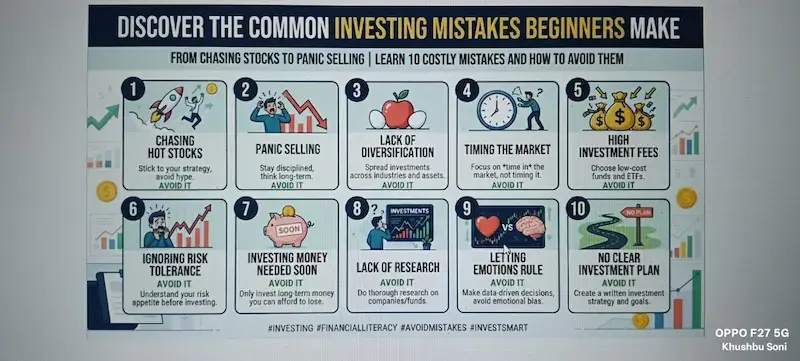
Investing can help you achieve long-term financial goals, preserve your purchasing power, and increase your wealth. However, discovering a stock that rises or purchasing an item at the right time are not only elements of successful investment. Your outcomes may be much more influenced by your choices, routines, feelings, and risk management.
Many newcomers join the market with the best of intentions but make blunders that may be prevented. Some people make unplanned investments. Some people panic when markets decline, chase equities after significant price jumps, follow social media advice, or spend excessive amounts of money in a single venture.
The issue is that these errors might eventually cost a lot of money.
You may develop better habits before risking your hard-earned money by being aware of the typical Common Investing Mistakes Beginners Make. You don’t have to become an expert trader or forecast every change in the market. All you have to do is comprehend the dangers and create a sound investing strategy.
What are the worst investment mistakes, then?
Let’s study it more closely.
READ MORE: https://marketmantra2026.in/what-is-the-3-candlestick-rule/ https://marketmantra2026.in/what-is-the-3-candlestick-rule/
1. Investing Without a Clear Goal
Investing without understanding the true purpose of the money is one of the first Common Investing Mistakes Beginners Make
Investing for a housing deposit that you might require in three years is not the same as investing for retirement. In a similar vein, funds meant for a long-term investment portfolio should typically not be handled the same manner as funds required for an emergency.
Your financial goal affects several important decisions, including:
The amount of risk you are willing to accept
How long can you continue to invest?
What kinds of investments could be suitable
The amount that you must save
How to react when the market is volatile
A youthful investor with a lengthy retirement horizon, for example, could have more time to bounce back from brief market downturns. That flexibility might not be available to someone who needs the money fast.
“What am I investing this money for?”
You could be investing before making a sound financial strategy if you are unable to provide a clear response.
2. Chasing Investments That Have Already Exploded
Imagine seeing an 80% increase in a stock within a few months.
Everyone is discussing it. Posts on social media highlight major achievements. The company’s future is being discussed on financial news channels. You feel like you’re missing out all of a sudden.
FOMO, or the fear of missing out, can take over in this situation.
One of the investing blunders that novices should avoid is purchasing an investment only because its price has increased significantly.
An investment is not always appealing just because the price is going up.
Let’s say a stock rises from $50 to $100. “This company is doing incredibly well,” a beginners may assume.
Has the company’s value increased enough to justify the new price?
Even with great goods, robust revenue growth, and skilled management, a company’s stock can still be expensive.
In order to make wise investments, one must look past recent price changes.
3. Trying to Time the Market Perfectly
Another common problem is believing that you can consistently predict when the market will reach its lowest or highest point.
Beginners may think:
“I’ll wait until the market crashes.”
Then the market falls 10%, but they expect another 10% decline.
It falls further, and fear increases.
Eventually, the market starts recovering, but they still wait because they believe another crash is coming.
Before they realize it, prices have moved significantly higher.
This cycle demonstrates why common investment mistakes to avoid include excessive attempts at market timing.
Nobody knows exactly what markets will do next week, next month, or next year.
Long-term investors often focus instead on having a consistent investment strategy. Depending on their circumstances, this might involve investing at regular intervals rather than trying to predict the perfect entry point.
The objective is not to eliminate uncertainty.
It is to avoid letting uncertainty control every decision.
4. Investing Money You May Need Soon
For brief periods of time, the stock market may be unpredictable.
During a market downturn, even a high-quality investment may suffer a substantial decrease.
If the money you invested is suddenly required for a significant cost, that presents an issue.
Consider investing the funds you’ll need for a down payment on a house the following year. You could have to sell at a loss if the market drops by 25% just before you need the money.
Your investing time horizon is important because of this.
Generally speaking, funds meant for long-term wealth creation should be handled differently from those required for immediate expenditures.
Prior to considering an investment, think about keeping a suitable emergency fund and ensuring that your basic financial needs are met.
5. Putting Everything Into One Investment
Investing too much of one business, industry, asset, or subject is one of the most risky common mistakes made by novices.
When your investment does extraordinarily well, concentration may be really effective.
However, the reverse is also true.
Let’s say an investor believes one technological business will be the next big winner and invests 90% of their capital in it.
The company’s stock drops 50% once it encounters a significant regulatory issue.
There might be a significant drop in the investor’s assets.
Diversification does not ensure financial success. Furthermore, all investment risk cannot be eliminated.
However, having a range of appropriate assets might lessen the harm caused by a single investment’s poor performance.
Diversification may entail various:
- Companies
- Industries
- Asset classes
- Countries
- Market sectors
The situation and risk capacity of the person should determine the precise degree of diversity.
6. Ignoring Fees and Expenses
When considered separately, investment fees might not seem like much.
A difference of 0.5% or 1% might not seem significant.
However, investing is a long-term strategy, and just like rewards, expenses may accumulate.
Over a long period of time, the investor may have more money in their account if two investments perform similarly before fees.
Depending on the investment, investors might run into:
- Expense ratios
- Trading commissions
- Advisory fees
- Account fees
- Sales charges
- Management fees
- Tax costs
This does not imply that the least expensive investment is always the best one.
Rather, investors should be aware of what they are getting and if the price is fair given the investment or service.
One of the easiest things to learn is how to reduce wasteful spending. common investment mistakes to avoid.
7. Panic Selling During a Market Crash
Investors are put to the test emotionally by market collapses.
It might be unsettling to see the losses on your account when an investment drops by 20%, 30%, or more.
The typical response may be:
“I have to leave before things get worse.”
Selling is sometimes the right choice. Reevaluating the position may make sensible, for example, if your initial investing thesis has altered significantly.
However, selling just because prices are declining might lock up losses and keep you from taking part in a future rebound.
The crucial query is not:
“Is the cost decreasing?”
Instead, inquire:
“Has my financial situation or the investment undergone a significant change?”
In times of stress, this distinction might assist investors in making more logical choices.
8. Following Social Media Investment Tips Without Research
Financial information is now easier to find than ever thanks to social media.
That may be helpful.
However, it also leads to another issue: anybody may appear to be an expert on the internet.
A viral post may assert that a certain stock would inevitably increase. A different inventor may guaranty that investors would get wealthy with a certain coin.
The issue is that the whole risk assessment underlying the forecast is rarely visible.
Do your own research before making an investment based on someone else’s notion.
Think about:
In reality, what does the firm do?
How does it make money?
Is it making money?
What is the amount of debt it has?
Is its appraisal fair?
Which risks might be detrimental to the company?
Does the investment align with your financial objectives?
You don’t have to become an expert in accounting.
9. Confusing a Great Company With a Great Investment
Even seasoned investors might make this tiny error.
Even if a company’s stock is overvalued, it might still be outstanding.
Let’s say a company has a significant competitive edge, solid revenue growth, devoted clients, and top-notch management.
These features are worthwhile.
However, future returns might be disappointing if investors get too hopeful and drive the stock price much above what the company’s projected earnings can sustain.
The price you spend has an impact on your investment results.
For this reason, investors frequently look at measures like:
- P/E ratio
- Revenue growth
- Earnings growth
- Free cash flow
- Debt levels
- Profit margins
- Return on capital
- Valuation multiples
An investment’s quality cannot be measured by a single measurement.
It’s crucial to refrain from thinking that “great company” equates to “great stock at today’s price.”
10. Expecting to Get Rich Quickly
Expecting remarkable profits in a short amount of time is perhaps one of the most typical mistakes novices make when investing.
People are drawn to stories of making $1,000 into $100,000 because they are thrilling.
Unusual success stories, however, might lead to inflated expectations.
Building wealth over the long run is typically far less spectacular.
Think about compounding’s power.
Future returns may build upon earlier profits if an investment expands and those gains stay invested. This can make a big difference over extended periods of time.
However, compounding necessitates something that novices sometimes overlook:
Time.
Focusing on developing a method that may generate riches over many years rather than continuously looking for the investment that will make you wealthy next month.
11. Ignoring Taxes
The money you actually keep and investment returns are not necessarily the same.
Depending on your nation, investment type, account structure, holding time, and applicable tax laws, taxes may have an impact on the result of your ultimate investment.
For instance, in certain countries, regular investment purchases and sales may result in taxable events.
This does not imply that investors should refrain from selling entirely.
It implies that before making significant investment decisions, taxes should be taken into account.
Consider speaking with a knowledgeable tax expert if you are unclear about the tax implications of an investment.
12. Using Too Much Leverage
Investing with borrowed funds can increase profits.
Losses may potentially increase significantly.
Let’s say you put in $10,000 of your personal funds. Your investment drops to about $8,000 with a 20% loss.
Imagine now taking out further loans to strengthen your position.
When interest expenses and repayment responsibilities are taken into account, the same market loss might result in a significantly greater financial hardship.
Leverage raises risk, but it’s not always a negative thing.
For novices, figuring out how much risk they can actually handle is considerably more crucial than attempting to optimize possible gains.
13. Constantly Changing Investment Strategies
Changing methods each time the market shifts is another example of a mistake made by novice investors.
An investor seeks technology stocks one year.
They desire dividend stocks the next year.
After that, students learn about cryptocurrency.
They then find gold.
The portfolio quickly turns into an assortment of disparate assets made for various purposes.
It’s not always necessary for a successful investing plan to adapt to shifting market conditions.
Frequently Asked Questions
1. What are the most common investing mistakes beginners make?
Investing without a plan, chasing stocks when they rise, attempting to timing the market, panic selling, inadequate diversification, ignoring fees, blindly following social media advice, and expecting fast returns are the most frequent mistakes made by novice investors.
2. What is the biggest mistake a beginner investor can make?
Investing without knowing the dangers or the nature of the investment is one of the worst mistakes. It is important for beginners to understand what they are purchasing, why they are doing it, and how much loss they can actually afford.
3. What investing mistakes should beginners avoid?
Putting all of their money into one investment, making rash judgments, utilizing excessive leverage, switching methods frequently, and investing money they might need for short-term costs are some significant investing blunders that novices should avoid.
4. Is it a mistake to invest all your money in one stock?
Indeed, investing too much in a single stock can lead to serious danger. A significant amount of your portfolio may be impacted if that firm has financial difficulties or if the price of its shares drops considerably. One way to lower company-specific risk is through diversification.
5. Should beginners try to time the stock market?
In general, beginners should use caution when attempting to anticipate market highs and lows on a regular basis. Even seasoned investors find it challenging to time the market. Emotional decisions can be lessened with a focused long-term investing approach.
6. Why do new investors panic when the market falls?
Seeing a fall in their portfolio might make new investors anxious because they fear losing even more money. They could sell during a slump and perhaps transform a brief decrease into a permanent loss if they don’t have a clear investment plan.