Investing is now easier than ever. Millions of people are starting the process of making money because of digital investing platforms and financial education. However, a common query among new investors is how mutual funds work for beginners.
Because they provide expert management, diversification, and a somewhat easy way to invest in financial markets, mutual funds are frequently suggested. Investors can pool their funds with others and allow seasoned fund managers make investment selections rather than examining dozens of individual stocks or bonds.
However, understanding the basic concept is insufficient. It’s crucial to understand how mutual funds work, how they produce returns, what risks they contain, and whether they align with your financial objectives before investing your hard-earned money.
Everything is explained in simple English in this complete beginner’s handbook. By the end, you’ll know how mutual funds work for beginners, the various kinds of mutual funds, how returns are produced, and what to think about before making your first investment.
READ MORE: https://marketmantra2026.in/top-5-mutual-funds-in-india-2026/ https://x.com/F55F/status/930109273165533184?s=20
What Is a Mutual Fund?
A mutual fund is a professionally run investment vehicle that combines the cash of multiple investors and spreads it among a range of assets, such as stocks, bonds, money market instruments, and a combination of these.
Instead of purchasing individual shares, you purchase mutual fund units. Whether the value of your investment rises or falls depends on how well the fund’s fundamental assets perform.
Think of it as a large investment basket. A trained fund manager selects the investments that belong in the basket, and each investor contributes money to it.
This approach makes investing more convenient for people who don’t have the time, knowledge, or resources to routinely follow financial markets.
How Mutual Funds Work
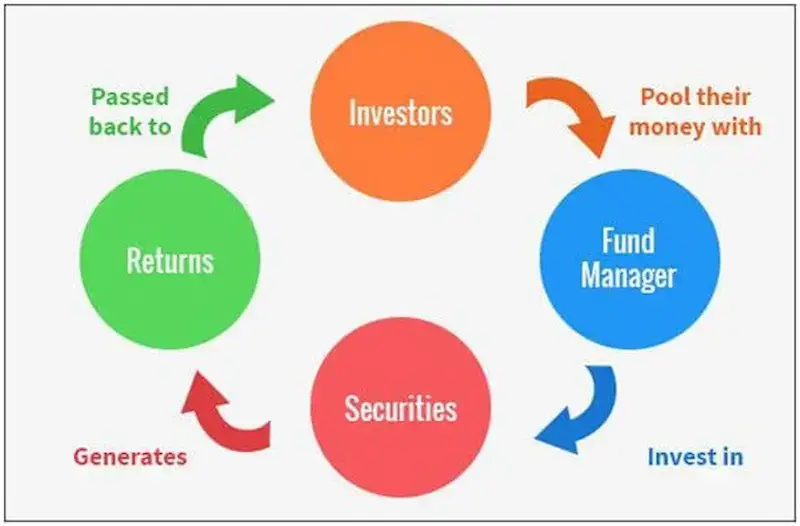
Let’s simplify the procedure down into easy steps so that beginners may grasp how mutual funds operate.
Step 1: Investors Pool Their Money
The same mutual fund receives deposits from thousands or even millions of investors.
Everyone’s funds are pooled into a single, sizable investment pool instead of being invested individually.
This makes it possible for investors to obtain a diverse portfolio that would otherwise need a substantially higher initial investment.
Step 2: Professional Fund Managers Invest the Money
Experienced fund managers invest the money in accordance with the fund’s goal after it has been obtained.
For example:
- Large-cap stock funds make investments in well-established businesses.
- Bond funds make investments in corporate or governmental bonds.
- A market index is tracked by index funds.
- Bonds and stocks are both invested in by balanced funds.
Before making investment selections, fund managers keep a close eye on business performance, economic developments, and market conditions.
Step 3: The Portfolio Generates Returns
The fund’s investments could yield returns by:
- Appreciation of capital
- Income from dividends
- Income from interest
- Profits from the sale of securities
Investors profit in proportion to the number of units they possess as the portfolio’s value increases.
Step 4: NAV Changes Daily
There is a Net Asset Value (NAV) for each mutual fund.
The value of a single mutual fund unit is represented by NAV.
It is computed by dividing the total number of outstanding units by the entire value of the fund’s assets (less its liabilities).
The NAV often rises if the investments do well. The NAV may drop if markets decline.
Step 5: Investors Earn Returns
Investors can profit in a variety of ways:
- An increase in NAV
- Payouts of dividends (if appropriate)
- Long-term growth in capital
This simple procedure explains why mutual funds are regarded as one of the easiest methods to invest and serves as the basis for how they operate for novices.
Why Mutual Funds Are Popular
Over the previous 20 years, mutual funds have experienced substantial growth.
Among the causes are:
- Expert administration
- The process of diversification
- Simple internet investment
- Minimal investment amounts
- Plans for automatic investments
- Numerous choices for investments
- Regulatory supervision
- Open reporting
Mutual funds oversee trillions of dollars’ worth of investor assets worldwide, demonstrating the trust that many people and organizations have in expertly managed investments.
Who Manages a Mutual Fund?
Many major players are involved in a mutual fund.
Fund Manager
The fund manager is responsible for selecting investments, monitoring the portfolio, and making purchasing and selling decisions.
Their purpose is to properly manage risk while achieving the fund’s declared goals for investment.
Asset Management Company (AMC)
The mutual fund is created and run by the Asset Management Company.
It offers tools for portfolio management, technology, compliance systems, and research teams.
Custodian
The fund’s securities are held securely by the custodian, who also makes sure that transactions are properly settled.
Trustee
By making sure the fund follows rules and its declared goals, trustees safeguard investors’ interests.
Types of Mutual Funds
Understanding that not all mutual funds invest in the same assets is one of the most important parts of learning how mutual funds work for beginners.
Different investment goals are the focus of different funds.
Equity Mutual Funds
The main investments made by these funds are in company stock.
They often have more potential for long-term growth, but they also see more price swings in the short term.
Ideal for:
- Long-term investors
- Creation of wealth
- Increased tolerance for risk
Debt Mutual Funds
Debt funds make investments in securities with fixed incomes.
Examples consist of:
- Bonds issued by the government
- Bonds for corporations
- Bills from the Treasury
Although they often have less room for development, these funds typically offer more consistent returns than equities funds.
Hybrid Mutual Funds
Bonds and equities are combined into a single portfolio by hybrid funds.
This balance seeks to maintain growth opportunities while lowering volatility.
They are frequently suitable for investors with a low level of risk.
Index Funds
Instead than trying to outperform a market index, index funds merely follow it.
Funds tracking is one example.
- S&P 500
- FTSE 100
- Nifty 50
- Sensex
Index funds typically have lower expense ratios because they require less active management.
Money Market Funds
These funds make investments in extremely short-term debt securities.
High returns are not as important to them as capital preservation and liquidity.
What Is Diversification?
Spreading investments throughout a wide range of assets rather than depending only on one business or investment is known as diversification.
Let’s say a mutual fund has interests in eighty different businesses.
Because so many other investments continue to provide returns, the total impact of a single company’s bad performance on the portfolio is minimal.
Although it can’t completely remove market risk, diversification helps lower company-specific risk.
For this reason, a lot of financial experts advise novice investors to use mutual funds.
Understanding Risk in Mutual Funds
No investment carries no risk at all.
Depending on the assets they contain, different mutual funds have different levels of risk.
Typical dangers consist of:
- Risk in the market
- Risk associated with interest rates
- Risk to credit
- Risk of inflation
- Currency risk (with regard to foreign funds)
- Risk to liquidity
For beginners, understanding these risks is crucial to comprehending how mutual funds operate.
Investors should always select funds that align with their risk tolerance, investment horizon, and financial objectives.
What Is an Expense Ratio?
It costs money to hire a professional fund manager.
Each mutual fund levies an annual fee known as the expense ratio.
This charge includes:
- Management of portfolios
- Examine
- Management
- Operational costs
- Conformity
Over time, investors can retain a larger portion of their investment profits with a reduced expense ratio.
Even slight variations in costs can have a big impact on total wealth when it comes to long-term investing.
How Do Mutual Funds Generate Returns?
There are three main ways that mutual funds usually produce returns.
Capital Appreciation
The portfolio as a whole expands when investment values rise.
Dividend Income
Some businesses give shareholders a portion of their profits.
The fund’s results include these dividends.
Interest Income
Bond funds receive interest payments from the debt instruments they possess.
Beginners can better understand how mutual funds operate and why various funds perform differently in different market conditions by understanding these return sources.
Are Mutual Funds Safe?
While they are regulated financial products, mutual funds are not guaranteed investments.
The performance of the market decides their worth.
However, diversified mutual funds frequently lower total investment risk when compared to investing in just one or two specific stocks.
Your chances of reaching your financial objectives can be increased by selecting well-managed funds, making long-term investments, and preserving diversification.
Frequently Asked Questions (FAQs)
How do beginners in investing use mutual funds?
Mutual funds combine the capital of numerous investors and allocate it to a variety of investments, including stocks and bonds. These investments are managed by qualified fund managers in line with the fund’s goals. This removes the need for investors to select individual stocks, making mutual funds easier for beginners to understand.
Are new investors safe using mutual funds?
Mutual funds are regulated investment products and are generally considered suitable for beginners. However, they are subject to market risk, and their value can rise or fall depending on the performance of the underlying investments. Choosing a fund that matches your financial goals and risk tolerance is important.
What is the minimum amount of money required to begin investing in mutual funds?
Each nation and fund provider has a different minimum investment amount. Through a Systematic dedication Plan (SIP) or a one-time commitment, several mutual funds let investors begin with comparatively small sums.
Can I lose money investing in mutual funds?
Indeed, returns are not guaranteed by mutual funds. Your investment may lose value if the market does poorly. Long-term investing and diversification can lessen risk, but they cannot totally remove it.
What kind of mutual fund is ideal for beginners?
Your time horizon, risk tolerance, and investing goal will determine which mutual fund is right for you. Because they provide wide market exposure and expert management, many beginners select low-cost index funds, balanced funds, or diversified equity funds.
What differentiates a lump sum investment from a SIP?
A lump sum investment is investing a greater money all at once, whereas a SIP entails investing a fixed amount at regular periods. While lump sum investments might do better if markets increase quickly after investing, SIPs help lessen the effects of market volatility.
How are returns on mutual funds calculated?
Interest earned by the securities in the portfolio, dividend income, and capital growth are the sources of mutual fund returns. The market value of the fund’s underlying investments affects its Net Asset Value (NAV).
Should I make long-term investments in mutual funds?
Because mutual funds profit from compounding and have more time to recover from short-term market swings, many investors utilize them as long-term investments. Investing over a number of years increases the likelihood of reaching financial objectives.
Conclusion
One of the most crucial steps to becoming a confident investor is learning how mutual funds work for beginners. By combining the capital of several investors and putting it under the management of seasoned experts, mutual funds offer an easy and accessible option to engage in the financial markets. They are a desirable choice for people who are just beginning their financial adventure because of their diversified approach, which helps spread risk across several assets.
Mutual funds are not risk-free, despite their many benefits, which include expert management, diversification, flexibility, and the possibility of long-term wealth creation. The possible returns vary by a number of factors, including market circumstances, investment goals, fund expenses, and your personal financial goals. Because of this, it’s critical to thoroughly investigate funds, comprehend their investment approach, and select solutions that fit your time horizon and risk tolerance.
The secret to effective investing is consistency, patience, and a long-term outlook, regardless of whether you use a lump sum or a Systematic Investment Plan (SIP). Focus on developing a disciplined investing habit and routinely monitoring your portfolio rather than attempting to forecast short-term market fluctuations.
You’ll be better able to make wise financial decisions, steer clear of typical blunders, and gradually move closer to your long-term financial objectives if you take the time to discover how mutual funds work for beginners.