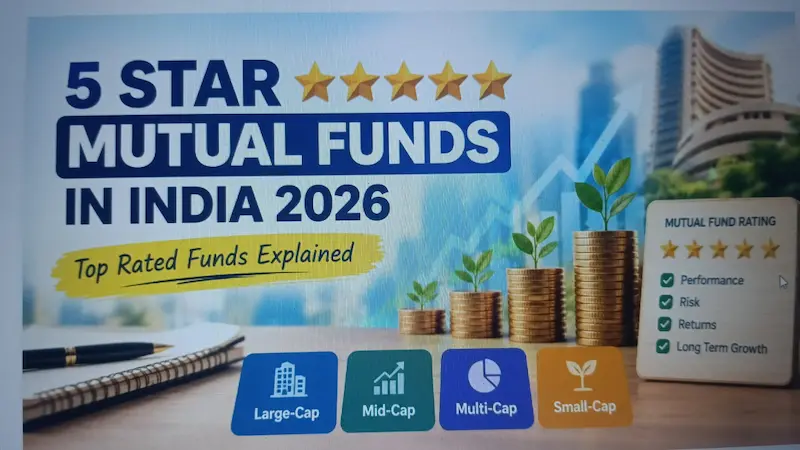
You have undoubtedly seen the well-known 5 star mutual funds in India 2026 next to several mutual funds if you have ever looked for the best ones to invest in. As it appears simple a lot of new investors are unaware that there is more to that figure.
| Mutual Fund | Category | Rating |
|---|
| Invesco India Large & MidCap Fund | Large & Mid-Cap | ⭐⭐⭐⭐⭐ |
| HSBC Midcap Fund | Mid-Cap | ⭐⭐⭐⭐⭐ |
| Invesco India Mid Cap Fund | Mid-Cap | ⭐⭐⭐⭐⭐ |
| Axis Multicap Fund | Multi-Cap | ⭐⭐⭐⭐⭐ |
| ITI Small Cap Fund | Small-Cap | ⭐⭐⭐⭐⭐ |
READ MORE: https://marketmantra2026.in/reliance-industries-12500-crore-bond-issue/ https://x.com/FundVeda/status/2101501854018650352?s=20
It is crucial to realize that a 5 star mutual funds in India 2026 is not a number that is universally accepted by the government. Various research firms assess mutual funds using their unique methods.
For example, Morningstar defines its star rating as a quantitative, retroactive metric based on the risk-adjusted performance of a fund in relation to similar funds. This distinction is important for investors looking into 5-star mutual funds in India in 2026 because different research platforms may assign different ratings to the same plan.
Invesco India Large & MidCap Fund, HSBC Midcap Fund, Invesco India Mid Cap Fund, Axis Multicap Fund, and ITI Small Cap Fund are the five equity funds that received a five-star rating in Value Research’s August 2026 rating cycle, according to a September 2026 rating report.
But should investors just choose a fund based on its five-star rating? Not always. A rating’s true worth lies in its ability to serve as a springboard for more in-depth investigation.
What Does a 5-Star Mutual Fund Rating Mean?
A 5 star mutual funds in India 2026 usually shows that a fund has done well on the rating provider’s approach after taking risk and returns into account.
However, the provider determines the precise computation.top first ranking Value Research claims that its fund rating is a numerical score that incorporates both risk and return.
Its approach assigns 40% weight to the three-year score and 60% weight to the five-year score for equity and hybrid funds.
Additionally, Morningstar’s star ranking is quantitative and retroactive. It compares the risk-adjusted past performance of a fund to that of comparable funds. Investors should therefore always ask, “Five stars according to whom?”
when looking for 5 star mutual funds in India 2026. Many misunderstandings can be avoided with just one question.
Which Mutual Funds Have a 5-Star Rating in 2026?
Five equity funds were rated five stars in Value Research’s August rating cycle report, which was released on September 3, 2026. They include small-cap, multi-cap, mid-cap, and large and mid-cap.
| Mutual Fund | Category | Rating Provider |
|---|---|---|
| Invesco India Large & MidCap Fund | Large & Mid-Cap | Value Research |
| HSBC Midcap Fund | Mid-Cap | Value Research |
| Invesco India Mid Cap Fund | Mid-Cap | Value Research |
| Axis Multicap Fund | Multi-Cap | Value Research |
| ITI Small Cap Fund | Small-Cap | Value Research |
This is not a permanent list; actually, it is a rating snapshot. Ratings for mutual funds are subject to change based on peer comparisons, risk, and performance. That is especially crucial for anyone who uses
5 star mutual funds in India 2026 as a search for potential investments rather than simply as an educational exercise.
1. Invesco India Large & MidCap Fund
The first fund in Value Research’s August 2026 five-star list was Invesco India Large & MidCap Fund.
According to Value Research’s study, the fund rated best over three years and second over five years based on SIP returns. Strong returns were accompanied by significant volatility, as evidenced by the fund’s 18.4% standard deviation and three-year and five-year SIP returns of 17.2% and 20.7%, respectively.
The fund offers investors exposure to businesses in both the large and mid-cap categories. The fund’s five-star rating is not the only important lesson for a novice. Whether the investment strategy and volatility align with the investor’s time horizon is a more pertinent concern.
2. HSBC Midcap Fund
HSBC Midcap Fund was another fund that earned five stars in the August 2026 rating cycle of Value Research. Value Research’s investigation revealed three-year SIP returns of 21.2% and five-year SIP returns of 23.6%.
Additionally, it recorded an alpha of 7.7% relative to the 1.55% category average. Medium-sized businesses are the main focus of mid-cap funds.
These companies may have great growth prospects, but there may also be major swings in their share values. Because of this, category-level risk is equally significant as the star rating.
Therefore, a five-star rating should not be interpreted as a guaranty of future profits but rather as a recommendation for additional investigation.
3. Invesco India Mid Cap Fund
The second mid-cap fund on the list was Invesco India Mid Cap Fund.
According to Value Research, the fund rated top over a ten-year period and second over a three-year and five-year period in terms of SIP returns. It claimed that over a ten-year period, the fund had produced annualized returns of almost 20% and had regularly exceeded its benchmark by nearly four percentage points annually.
Because they offer more context than a single successful year, long-term statistics might be helpful. However, past performance should not be taken as a guaranty that it will continue.
This is a crucial differential for investors comparing five-star mutual funds in India in 2026. A rating does not forecast a fund’s exact earnings for the upcoming year; instead, it describes past performance.
4. Axis Multicap Fund
Axis Multicap Fund was the multi-cap fund on Value Research’s five-star rating. Value Research reported that after five years of operation, the fund topped its category and benchmark in terms of three-year SIP returns.
Because they invest across market-cap groups, multi-cap funds differ structurally from pure large-cap, mid-cap, or small-cap funds. This does not completely remove equity-market risk, but it can expose the portfolio to several market segments.
Therefore, it is crucial for investors to learn about the category while rating five-star mutual funds in India in 2026. The portfolio risk related with a five-star small-cap fund versus a five-star multi-cap fund differs.
5. ITI Small Cap Fund
The fifth fund was ITI Small Cap Fund.
VAccording to Alue Research’s August 2026 analysis, the fund rated first on five-year SIP returns and second on three-year SIP returns.
Additionally, it stated that the fund had previously underperformed both its category and benchmark for a considerable amount of time before improving, with an alpha of 10.8% compared to a category average of 3.3%.
The final point is really intriguing. It illustrates why investors should not base their decision about a fund only on its present rating. There may be times in a fund’s history when its relative performance was both excellent and poor.
Investment horizon and risk tolerance are crucial factors to take into account because small-cap funds can be significantly more volatile than diversified large-cap strategies.
Why Can a 5-Star Rating Change?
Ratings for mutual funds are not permanent rewards. A fund’s rating may change in response to changes in its risk profile, past performance, or the risk-adjusted performance of rival funds.
Because rating systems compare funds with their peers, this is particularly important. Let us say a fund gives a good return, but a number of other funds outperform it with less volatility.
Even if the fund has not suddenly turned into a bad investment, its relative rating may change. For this reason, investors should consider 5-star mutual funds in India 2026 to be a temporary study category rather than an ongoing ranking.
Does a 5-Star Rating Mean the Fund Is the Best?
No.
One research input is a star rating. A five-star rating should be viewed as a beginning point rather than a final conclusion, according to Value Research itself. Risk tolerance, investment horizon, budget, and more general financial objectives are all included in its investor checklist.
Because different investors have varied needs, this is especially crucial. For instance, a young investor with a lengthy investing horizon would not mind a small-cap fund’s volatility.
The same degree of equity-market risk might not be desired by another individual who is saving for a short-term financial objective. That choice cannot be made for you by the rating.
5-Star Rating vs Mutual Fund Risk
One of the most common errors made by novices is mistaking a high grade with minimal risk. During a market correction, a five-star equities fund may nevertheless experience a substantial decline. The category is important.
In general, a large-cap fund and a small-cap fund act differently. The volatility of a multi-cap approach may differ from that of a mid-cap fund. The dangers associated with a debt fund are very different.
Morningstar’s methodology, which bases its star rating on risk-adjusted historical performance rather than just returns, shows why risk is important.
Therefore, do not stop at the stars when looking for 5-star mutual funds in India in 2026. Compare historical drawdowns, category, investment style, volatility, and portfolio concentration.
How Should Beginners Evaluate a 5-Star Mutual Fund?
The research process can be made simpler with a basic five-step method.
1. Check the Fund Category
Decide the fund’s kind first: large-cap, mid-cap, small-cap, multi-cap, flexi-cap, hybrid, or debt. You may learn a lot more about the kind of portfolio exposure you are receiving from this.
2. Look Beyond One-Year Returns
An outstanding headline might be produced in a single successful year. Instead, look at performance over three, five, and, if available, longer time periods.
Additionally, instead of comparing unrelated funds, compare the fund with its proper benchmark and category.
3. Understand the Risk
Analyse portfolio concentration, maximum drawdowns, and volatility. A fund that achieves comparable outcomes with less volatility should be assessed differently from one that produces excellent returns with significantly higher risk.
4. Examine the Portfolio
Examine the portfolio’s sector allocation, major holdings, and whether it has grown concentrated in a limited number of stocks.
The diversification effect of having two five-star funds may be diminished if their assets are strikingly similar.
5. Consider Your Own Goal
Your financial plan should be suitable with a mutual fund. Find out how long you can invest, how much volatility you can handle, and the ultimate goal of the funds.
This is more helpful than choosing a fund based only on its five-star rating.
What About Morningstar 5-Star Funds?
Although Morningstar also offers star ratings for mutual funds in India, Value Research and Morningstar’s ratings should not be taken at face value.
According to Morningstar, its star rating is a quantitative, risk-adjusted metric that looks backward in relation to similar funds. Investors can filter mutual funds by rating and category using a special star-rating tool on its website.
For example, ICICI Prudential Short Term Fund Direct Plan Growth received a five-star rating on September 17, 2026, while ICICI Prudential Medium Term Fund Direct Plan Growth received a five-star rating on September 8, 2026, according to Morningstar’s September 2026 statistics.
This explains why a list of five-star mutual funds should always include the rating provider and rating date.
Are 5-Star Mutual Funds Suitable for SIPs?
A fund is not always appropriate for a SIP just because it has a five-star rating. Simply put, a SIP is an investing strategy where funds are invested on a regular basis.
The fund type, investment horizon, risk tolerance, and financial goal all influence whether a given fund is suitable. Investors may assess a fund’s consistency in various market scenarios for long-term equity goals.
But even then, diversification matters. If multiple funds with five-star ratings have a large number of the same companies, this does not necessarily result in a diverse portfolio.
Should You Buy a Fund Immediately After It Gets Five Stars?
Not always. Investor interest may be increased by a rating change, but purchasing a fund right away only because it has five stars may promote performance chasing.
Performance in the past is subject to change. The state of the market is subject to change. Portfolios of funds are subject to change.
Alternatively, investors may take the grade as a catalyst to delve more into the fund. Examine its investment approach, fund management background, portfolio, category, expense ratio, risk metrics, and performance throughout various market periods.
How Often Should You Check Mutual Fund Ratings?
Checking ratings on a daily basis is not necessary for everyone. Over-monitoring might make needless noise for long-term investors.
A review on a regular basis may be more beneficial. Investors can verify whether the portfolio still fits their overall asset allocation, whether the fund’s strategy has altered, and whether it still aligns with their investment goal.
Although ratings can offer more details throughout this research, they should not be the only factor considered when making a purchase or sale.
The Bigger Lesson Behind 5-Star Ratings
For beginners, that is an important idea. Consider two funds. Although Fund A yields a higher return, its movements are far greater.
Although Fund B generates a little lower return, it does so with significantly less volatility. Fund A can appear better just by comparing the return figures.
A more insightful question can be asked by risk-adjusted analysis: how much risk did the investor accept in order to get those returns? For this reason, when applied rightly, star ratings can be helpful.
Final Thoughts
The list of 5 star mutual funds in India 2026 is not a permanent list of winners. Ratings are snapshots based on a certain date and methodology.
Five equities funds—Invesco India Large & MidCap Fund, HSBC Midcap Fund, Invesco India Mid Cap Fund, Axis Multicap Fund, and ITI Small Cap Fund—received five stars in Value Research’s August 2026 rating cycle.
Certain funds, such as ICICI Prudential Short Term Fund Direct Plan Growth and ICICI Prudential Medium Term Fund Direct Plan Growth, have five-star ratings according to Morningstar’s current 2026 data, showing that various rating agencies can provide different outcomes.
For anyone researching 5 star mutual funds in India 2026, Treating the rating as a starting point for study rather than a final investment choice is the best course of action.
Check the fund category. Analyze long-term results. Accept volatility. Look over the portfolio. Review your spending.
Verify if there are any overlaps between different funds. Above all, confirm that the investment aligns with your financial goal and time frame.
Five stars can indicate that a fund has performed well according to a specific rating system. They are unable to advise you on the suitability of that fund.
Disclaimer
This article is for educational purposes only and is not investment advice. Mutual fund investments are subject to market risks. Ratings can change over time, and past performance does not guarantee future results. Always check the latest fund factsheet, portfolio, official documents and current rating before making an investment decision.